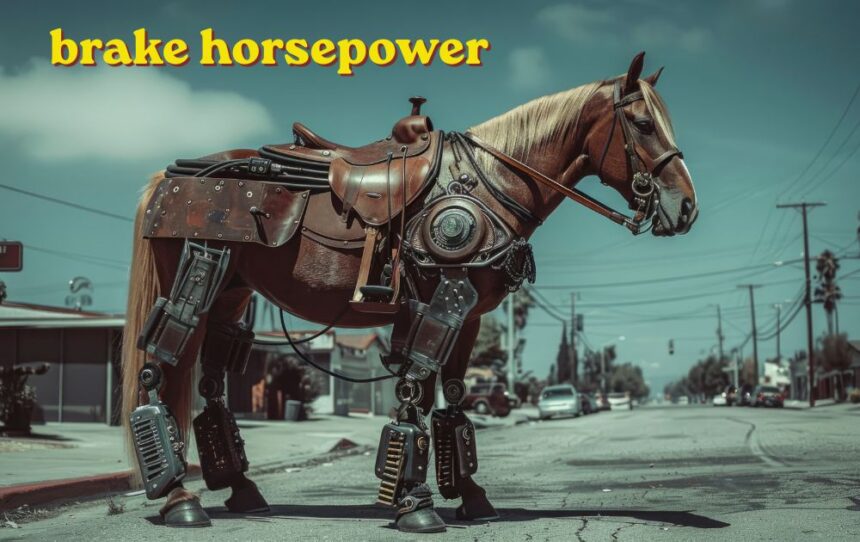
Brake horsepower is a term you’ll hear constantly if you spend any time around car shows or used car listings.
Car enthusiasts throw this phrase around all the time, and dealers love to mention it too, but very few people actually stop to explain what brake horsepower really means.
It sounds technical at first, almost like something only mechanics understand.
But once you get your head around brake horsepower, you’ll find it’s genuinely one of the simplest ways to judge how a car actually performs on the road.
Every time you check a used car listing, you’ll likely spot a brake horsepower figure sitting right next to the engine size.
This number tells you far more about the car than most buyers realise, and understanding brake horsepower puts you in a much stronger position before you spend your money.
Whether you’re comparing two similar hatchbacks or trying to work out if a performance car is worth the extra cost, brake horsepower gives you a real, honest answer.
It cuts through the marketing spin and shows you what the engine can genuinely deliver.
A lot of buyers assume bigger numbers always mean a better car, but brake horsepower is a bit more nuanced than that.
It reflects real-world performance, not just raw engine specs printed on a brochure.
So, in this guide, we’ll walk you through everything worth knowing about brake horsepower.
Let’s break it down from the start, right through to how it applies to your car today, so you never feel confused by a BHP figure again.

Origins of Brake Horsepower
Long before engines existed, people relied on horses and other farm animals to get heavy work done. Tasks like ploughing fields, hauling goods, and heavy lifting were all handled by animal muscle.
This domestication of animals for industrial activities was, in its own way, a massive technological leap for its time.
Then came the industrial revolution, and everything changed. Steam engines started to replace horses, and mine operators along with factory managers needed a proper way to compare these new machines to the animal labour they knew so well.
That’s where a Scottish engineer named James Watt stepped in during the 18th century. He created a proper unit of measurement the whole industry could rely on.
Watt figured that what took one horse roughly half a day to do could now be measured against a machine’s output.
He looked closely at specialised tasks, worked out the power rating of these early steam powered engines, and gave the world horsepower.
This term is still used for transportation and engine power output today.
It’s honestly one of the most interesting bits of automotive history, showing just how much physical effort and hard labour used to go into things we now take for granted.
Even comparing an engine to five men or an ox working together shows how clever this early invention really was.
From flour mills to factory floors, this early power comparison eventually evolved into what we now call brake horsepower.
The workers and managers of that era would probably be amazed at how far the concept of brake horsepower has come.
What Is BHP? Understanding Brake Horsepower
So, what actually is brake horsepower? In simple terms, it’s the usable power an engine produces after accounting for everything that eats into its theoretical power output.
Think of brake horsepower as the real, honest number, not just the figure printed on paper.
It looks at the total power output of an engine and subtracts the losses caused by things like friction, the gearbox, and the alternator.
Your car’s engine also has to run other systems while it’s working, such as the air conditioning and the water pump. All of this pulls from the engine’s strength.
These are known as the additional loads and basic loads placed on the engine.
Once you factor in friction loss and general power loss, you get a number that reflects real-world conditions far better than a raw spec sheet ever could.
This is exactly why brake horsepower matters so much when comparing cars. It’s not just about engine speed or torque; it’s about how much force exerted by the engine actually translates into real performance.
Once vehicle weight, aerodynamics, and mechanical components are taken into account, BHP gives you a realistic assessment and a proper power output measurement.
This is far more useful than a number pulled from a lab with no load applied.
The generator and other small parts also play their part in this actual performance calculation, which is why manufacturers rely on brake horsepower so heavily.
HP vs BHP: What’s the Real Difference
People often use horsepower and BHP as if they mean exactly the same thing, but there’s a slight difference worth knowing about.
Even seasoned car enthusiasts mix these terms up, which only adds to the confusion when comparing vehicles.
Horsepower measures the raw engine power an engine produces, full stop, without worrying about inefficiencies in getting that power anywhere useful.
It’s a theoretical number, calculated straight from the engine itself, before anything gets in its way.
BHP, on the other hand, is more specific. It measures power sent to wheels, meaning it accounts for mechanical losses and power transmission issues along the way.
This makes BHP a far more honest reflection of real driving performance.
This is the figure that actually matters when it comes to acceleration, because it reflects power reaching wheels rather than just power sitting inside the engine block.
A car might boast strong horsepower on paper, yet still feel sluggish if its BHP figure tells a different story.
That’s why relying purely on horsepower can be misleading.
BHP strips away the guesswork and shows you exactly how much usable power your car delivers once everything else has taken its share.
So while both terms get used interchangeable in everyday conversation, and both act as a useful car performance indicator, BHP is the one that tells you how much of that total power output actually helps propel car forward. It’s the number that reflects what you genuinely feel behind the wheel.
Understanding this overall measure helps you make sense of spec sheets without getting confused by different measurement methods.
Once you know the difference between horsepower and BHP, reading any car listing becomes far less overwhelming.
Torque vs Brake Horsepower
Torque and BHP are both performance indicators, but they measure very different things. Torque reflects the highest power output a car can produce when it’s really pushing itself.
Think of towing a heavy trailer or climbing a steep hill under hardest work conditions, that’s torque doing the heavy lifting.
BHP, meanwhile, gives you an overall measure of how the car performs across a range of driving conditions, not just at its peak moment.
Torque is what you feel when you put your foot down. Brake horsepower is what tells you how the car holds up over a normal drive.
Both numbers matter, and looking at just one only gives you half the picture of true car performance.
How Is Horsepower Measured
The original horsepower definition came from James Watt’s clever, if slightly odd, experiment.
He worked out that one horse could pull weight of about 150lb weight out of a hole that was 220 feet deep.
He used this to create a metric measurement that others could follow for years to come.
In more familiar terms, 1 horsepower equals the energy exerted to move a 75kg weight up 1 meter in 1 second. Of course, the actual amount a horse can shift depends heavily on horse size.
A horse asked to move a 500kg weight will end up as a tired horse fairly quickly. This meant you’d need full day work and several horses to keep up the same output.
This is exactly why factory managers and mine operators found this kind of work done comparison so useful back in the day.
It let them measure how much more they could achieve with a machine compared to an average-sized people and horse combination.
Even now, this old engine horsepower theory still applies.
A car like the Vauxhall Corsa, producing around 80hp, could technically lift about 80 average-sized people 1m height off the ground in 1 second.
It’s a fun way to picture what horsepower actually represents, in terms of force exerted and raw steam engine comparison history.
How Brake Horsepower Is Measured Using a Dynamometer
Measuring brake horsepower today is far more precise than Watt’s original horse-and-weight experiment, though the idea behind it hasn’t changed much.
Engineers use a measuring device called a dynamometer, which is connected directly to the engine during engine testing.
The dynamometer works by creating a real-world conditions simulation, applying a load applied to the engine much like it would experience out on the road.
While this happens, it measures the torque the engine produces along with its rotational speed. From these two readings, a proper brake horsepower calculation can be made.
It’s a simple but effective process, and it’s the reason manufacturers can confidently print a BHP figure on the spec sheet rather than just guessing.
Factors That Influence Brake Horsepower
A number of things can quietly chip away at an engine’s power before it ever reaches the wheels.
Inside the engine components, frictional losses happen around parts like the piston rings, bearings, and the valvetrain.
All of these reduce the final output of the engine over time.
On top of that, various auxiliary components draw power just to keep the car running smoothly.
The alternator, the water pump, and even the air conditioning all demand a share of the engine’s strength.
This contributes to the overall power consumption of the vehicle.
Add these together and you get a noticeable power output reduction. This is exactly why brake horsepower figures are always lower than the engine’s raw theoretical power. It’s not a flaw, it’s just physics doing its job.
Why Brake Horsepower Matters for Your Car
Knowing an engine’s brake horsepower genuinely helps when it comes to making informed decisions about a car. It plays a role in towing capacity, acceleration, and overall power delivery.
These are all things that matter whether you’re buying a family car or something sportier.
For manufacturers, brake horsepower is a critical metric tied closely to engine performance and engine efficiency.
It helps them balance performance maximisation with strict emissions standards.
This isn’t always an easy job, given how much automotive technology has advanced in recent years.
As measurement precision has improved, manufacturers have gotten better at power losses reduction.
This means squeezing more usable power out of every engine while keeping consumers happy with the vehicle capabilities they actually care about.

Checking Your Car’s Brake Horsepower
If you’re buying a used car, checking its brake horsepower can tell you a lot about the engine health indicator side of things.
A quick check through a registration plate database using the registration number can reveal a lot.
This includes the BHP retention of the vehicle, alongside basic details like vehicle make, model, and fuel type.
Services like Total Car Check don’t stop there either.
They can flag a stolen vehicle record, confirm road tax and V.E.D status, and show full MOT history.
You’ll also get fuel cost estimates and fuel economy figures, all useful for proper vehicle history research before you hand over any money.
If something does seem off with the BHP, it’s worth booking an engine inspection at your local garage or a Kwik Fit centre. Sometimes the fix is as simple as an engine treatment.
Other times it might need a gasket replacement, but either way, your dealership should be able to advise the appropriate action to take.
Get a Basic Car Check for Free
Before you commit to buying anything, running a free car check genuinely gives you peace of mind.
It can reveal stolen vehicle status, confirm current road tax status, and even show average mileage per year.
This helps massively with buying safety before you sign anything.
These checks typically pull from a huge range of data fields, giving you a clear picture before any vehicle purchase.
If you want to go a step further, opting for a Gold Check gives you even deeper details.
Electric Vehicles and Brake Horsepower
Things work a bit differently for electric vehicles. Instead of brake horsepower, an EV’s output gets measured in kilowatts, usually written as kW.
BHP equivalents are often listed too, so buyers can compare more easily against petrol cars and diesel cars.
On average, energy consumption for an EV sits around 2000 kWh per year, measured in kilowatt-hours, although this varies depending on driving habits.
One clever feature worth mentioning is regenerative braking, where the thermal energy from the brake pads, along with tire friction, gets converted into usable battery power.
This power regeneration happens because EVs run on a single gear, unlike petrol cars with multiple gears.
It’s one of the neatest bits of engineering in modern electric vehicles, turning wasted energy into something genuinely useful for the car’s kWh range.
Final Thoughts on Brake Horsepower
From James Watt’s ground-breaking work during the industrial revolution to today’s precise modern measurement techniques, brake horsepower remains a fundamental concept in the automotive industry.
It has stood the test of time, and it still shapes how we judge engines more than two centuries later.
Whether you’re browsing used car listings, sitting in a dealership, or reading through a spec sheet at home, brake horsepower gives buyers and manufacturers alike a reliable way to judge engine power potential and make proper vehicle comparison possible.
It’s not just a number for engineers to obsess over either. Brake horsepower directly affects how a car feels to drive, how quickly it accelerates, and how confident you feel behind the wheel, especially when overtaking or merging onto a motorway.
Understanding brake horsepower also protects you as a buyer. It stops you from being swayed purely by marketing language, and instead gives you a genuine figure to compare one car against another, fairly and accurately.
So next time you hear someone talking about engine revving or bragging about their car’s numbers, you’ll know exactly what’s behind those figures.
You’ll understand the friction losses, the mechanical components, and the real-world conditions that shape every single brake horsepower rating.
That’s the real story of brake horsepower, a term born from horses and steam engines, yet still powering the way we understand cars today.
FAQs
What is wheel horsepower?
Wheel horsepower is the actual power that reaches the wheels after friction and mechanical losses reduce the engine’s total output.
What is the difference between brake horsepower and torque?
Brake horsepower measures overall engine performance across driving conditions, while torque measures the highest power output during hardest work.
What is the brake horsepower formula?
Brake horsepower is calculated by multiplying torque by engine speed and then dividing the result by a standard constant.
How do I check the brake horsepower of my car?
You can check your car’s brake horsepower using its registration number through a free BHP check or vehicle history database.
What is the difference between brake horsepower and horsepower?
Horsepower shows the engine’s raw power output, while brake horsepower shows how much of that power actually reaches the wheels.