Coilovers vs struts, every car guy I know has stood in a shop nodding along while a mechanic threw around suspension lingo they barely understood. Shocks, struts, and coilovers are three of the most misused terms in the automotive world. Getting this right before you spend your hard-earned money is not just smart, it is absolutely necessary.
The old rule that full-frame vehicles use shocks and unibody vehicles use struts no longer holds up in modern automotive design. What all three systems share is their job of helping your car absorb road energy, keeping your tires in solid contact with the ground. The moment that contact breaks down, your steering and handling suffer and so does your safety.
Shocks: The Quiet Force Manager
Shock absorbers work by dampening the forces that travel up through your tires after hitting a bump, converting raw energy into heat so your vehicle stays stable. Without working shocks, your wheels bounce and vibrate constantly, which is both unpleasant and genuinely dangerous.
Shocks are not structural components; your vehicle stays supported by coil springs, leaf springs, control arms, and the axle even when shocks are doing their job. If you remove the shocks in a true emergency, the car can technically still drive and steer, though the damping disappears entirely.
Good shocks make coil springs and leaf springs work smarter by controlling how fast they compress and rebound after hitting a bump. Every mile you drive, your shock absorbers are silently processing road energy and turning chaos into a controlled, predictable drive.
Struts: A Complete Structural System
Struts are not just shock absorbers with a different name they are a complete structural system in one package. The MacPherson strut serves a genuine dual purpose: it acts as a shock absorber while simultaneously functioning as a structural link between your vehicle and the spindle or knuckle. Without struts, the vehicle becomes completely immobile because the coil springs have nowhere to live.
When road forces travel through your tires and into the coil springs, the strut immediately begins dampening those forces before they reach the chassis. On steering axles, the upper strut mount uses bushings or bearings that allow the entire strut to spin so your wheels can turn without resistance.
A car with failing struts handles nothing like a car with worn shocks; the alignment drifts, wheel position becomes unreliable, and the entire feel of the chassis changes in a way that feels genuinely unsafe. Replacing struts demands more skill, more tools, and more respect than swapping out a basic shock.
Coilovers vs Struts: What Makes Coilovers Different
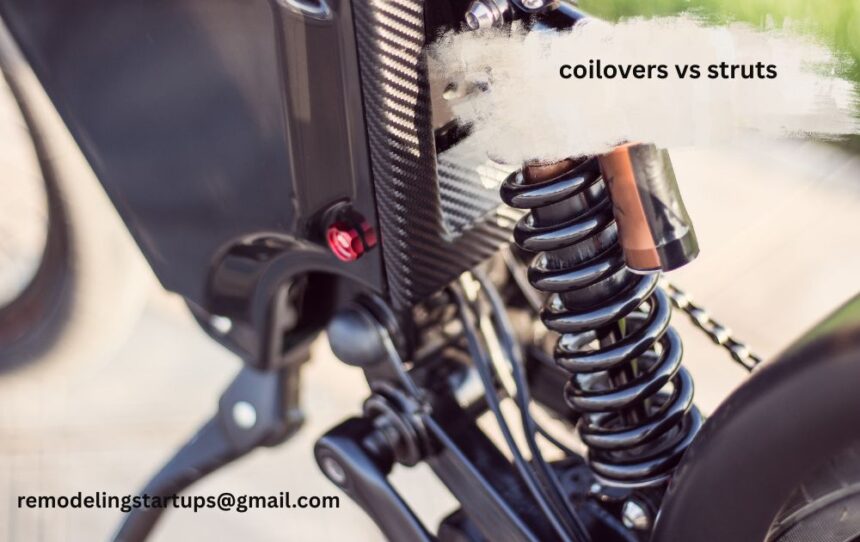
A coilover which stands for coil spring over shock bundles a shock absorber, coil springs, and all necessary mounting components into one clean single unit. Many quality coilovers feature a screw thread machined directly into the body, letting you manually raise or lower the entire assembly and dial in your preferred ride height.
Unlike a strut, a coilover is not an integral component of the suspension structure. If you remove one, the car settles onto its bump stops but can technically still drive and steer in a limited capacity. That distinction tells you everything about how coilovers prioritize performance and adjustability over structural necessity.
Race vehicles get completely transformed by a well-chosen set of coilovers, drivers adjusting damping levels between sessions, dialing in coil spring tension for different surfaces. Whether your goal is a slammed street vehicle or a lifted off-road beast, coilovers give you the fine-tuned adjustability to build exactly the suspension character you want.
Coilovers vs Struts: Handling Characteristics
Anyone who has driven on both coilovers and struts knows immediately that coilovers give you a completely different connection to vehicle dynamics. By adjusting damping force settings, coilovers let you cater to specific driving conditions, tightening up for sport track driving or softening for a long highway stretch.
Struts offer a more predictable and consistent handling profile that suits drivers who value stability over specific tuning flexibility. For factory-tuned daily drivers, that level of performance is honestly more than enough.
The gap between the two systems becomes most obvious when you push your driving style to its limits coilovers respond and adapt while struts hold their ground with quiet, reliable confidence.

Ride Comfort: Coilovers vs Struts Side by Side
The beauty of coilovers is that they put the ride entirely in your hands. You decide whether you want a stiffer setup or a softer ride based on your preference. You can shift the suspension’s entire character with a few turns of the adjustment collar without touching anything else on the car.
Struts take a more fixed approach to ride quality, engineered by the manufacturer to balance comfort, performance, and vehicle design goals into one consistent package. That works reliably for the majority of drivers who just want a dependable daily ride.
For those who treat their car as an extension of their driving style, coilovers with deep adjustability offer a level of customization that no fixed strut setup can come close to matching.
Installation and Maintenance: Coilovers vs Struts
Replacing struts is one of the more labor-intensive jobs in suspension work; the entire assembly must come out, the spring compressed safely, the upper mount disconnected, and the old unit carefully swapped. Proper technique and the right tools matter enormously when working with struts.
Coilovers offer a more straightforward install thanks to their compact design; everything arrives as a complete assembly that bolts in without disassembling multiple surrounding components. That said, coilovers demand consistent maintenance that struts simply do not, including regular inspection of damping settings, spring condition, and thread cleanliness.
No matter which system you choose, always follow up any adjustment or replacement with a full wheel alignment to eliminate abnormal tire wear and prevent premature suspension wear.
Cost Analysis: Coilovers vs Struts and Your Budget
Nobody walks into a coilover purchase without feeling the price difference. These systems cost significantly more than standard struts because of the additional components, engineering precision, and built-in adjustability. For budget-conscious drivers who just need reliable everyday suspension performance, stock replacement struts deliver genuine value.
The upfront cost of coilovers carries real justification when you factor in how precise adjustments reduce unnecessary stress on surrounding suspension components, potentially extending the overall lifespan of the system.
If your budget supports it and you plan to keep your car long enough to benefit, choosing quality coilovers over basic struts is a decision most drivers end up standing behind completely.
How to Choose: Coilovers vs Struts for Your Vehicle
The honest answer to the coilovers vs struts debate always starts with one question: what is your vehicle type and what is its intended use? Performance cars that see track time benefit enormously from coilovers because of their ability to lower ride height and maximize grip through every corner.
Everyday drivers who commute on normal roads will find quality struts more than adequate, reliable, comfortable, and completely suited to real-world driving habits. If changing your car’s stance or experimenting with ride height is something you genuinely care about, coilovers hand you that freedom without requiring major surgery every time.
Always spend time with professionals who specialize in vehicle tuning and suspension work before making this decision. The best setup honestly reflects how you drive, where you drive, and what your budget can support.
Notes on Platform-Specific Design
Some vehicle platforms use a modified MacPherson suspension design where the coil spring sits inboard from the strut rather than wrapping around it, which changes the load distribution across the entire suspension geometry. The 1979-93 Fox Body Mustangs are one of the most well-known examples of this modified layout.
Many manufacturers and vendors also use the terms struts and coilover shocks completely interchangeably in their marketing, even when the components serve technically different structural roles. This overlap is especially common in multi-link and double wishbone suspensions, where the boundary between a true strut and a coilover shock blurs depending on how the design integrates the components.
Understanding these platform differences arms you with the confidence to ask better questions and avoid overpaying for parts that do not match your actual suspension needs.
When it comes to coilovers vs struts, the right choice depends entirely on how you drive, what you drive, and how much involvement you want in shaping your car’s suspension character.
FAQS
Can you drive daily with coilovers?
Yes, as long as you choose street-oriented coilovers with softer spring rates and adjustable damping instead of track-focused setups.
What are the disadvantages of coilovers?
They are significantly more expensive, deliver a stiffer, harsher ride, and demand regular maintenance to prevent rust or seized collars.
Which suspension gives the smoothest ride?
Air suspension is unmatched , it uses pressurized air bladders to absorb road imperfections and delivers a floating, cloud-like ride quality.
Coilovers vs struts , which is better for ride quality?
For most daily drivers, struts win because they deliver a balanced, predictable ride without any tuning or adjustment needed.
Do coilovers replace struts?
Yes , on strut-based suspensions, coilovers bolt directly in and take over both the structural role and damping function with added height adjustability.